
Shelby Township Dentist » Services » Restorative Dentistry » Dental Implants
Dental Implants in Shelby Township, MI
Permanent Replacements for Missing Teeth. Serving Shelby Township, Macomb, Clinton Township, and Sterling Heights, MI
A dental implant is a titanium post placed in the jawbone that acts as an artificial tooth root, topped with a custom crown. At McKinley-Holloway Legacy Dentistry in Shelby Township, implants are planned from a 3D cone beam scan and placed using a surgical guide printed in our office. Call (586) 685-0880 to book your free consultation.
New patients get a free initial implant consultation, a $200 value, including the 3D scan we use to plan the case. You will know whether you are a candidate, what it will take, and what it will cost before you commit to anything. Ask our office for details. Call (586) 685-0880 or book your free implant consultation.
Why Choose McKinley-Holloway Legacy Dentistry for Dental Implants?
Planned in 3D, Placed With a Guide We Print On Site
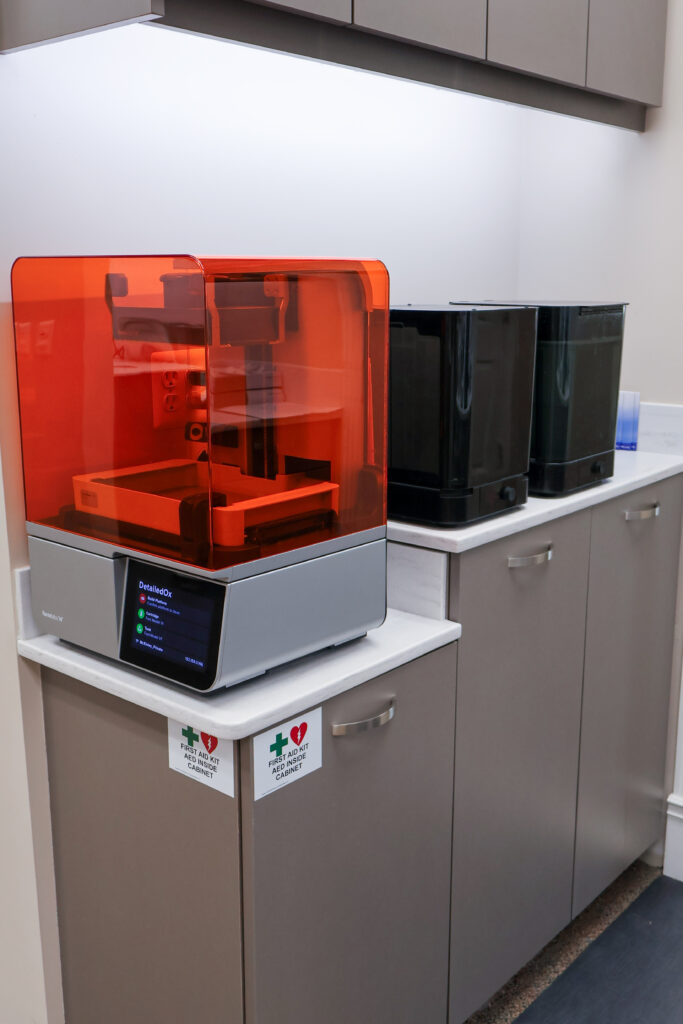
Your implant is mapped on a 3D cone beam scan that shows bone depth, density, and the path of the nerve before anything is placed. From that plan we print a surgical guide on our in-office Formlabs printer, so the implant goes exactly where it was planned rather than where it looked right on the day. Most practices send that step to an outside lab.
One Dentist From Plan to Placement to Crown
Dr. Brittany McKinley-Holloway is the only dentist in this practice. The person who plans your implant is the person who places it and the person who seats the final crown, with no handoffs between offices and no waiting on a specialist’s schedule. Patients rate the practice 4.9 stars across 400+ Google reviews.
Numbing and Sedation Built for Nervous Patients
Implant surgery is the appointment patients dread most, so we start with The Wand, a computer-controlled system that delivers anesthetic slowly to one tooth and removes the sting of the injection. Laughing gas and oral conscious sedation are both available for the placement appointment.
What Are Dental Implants and How Do They Work?
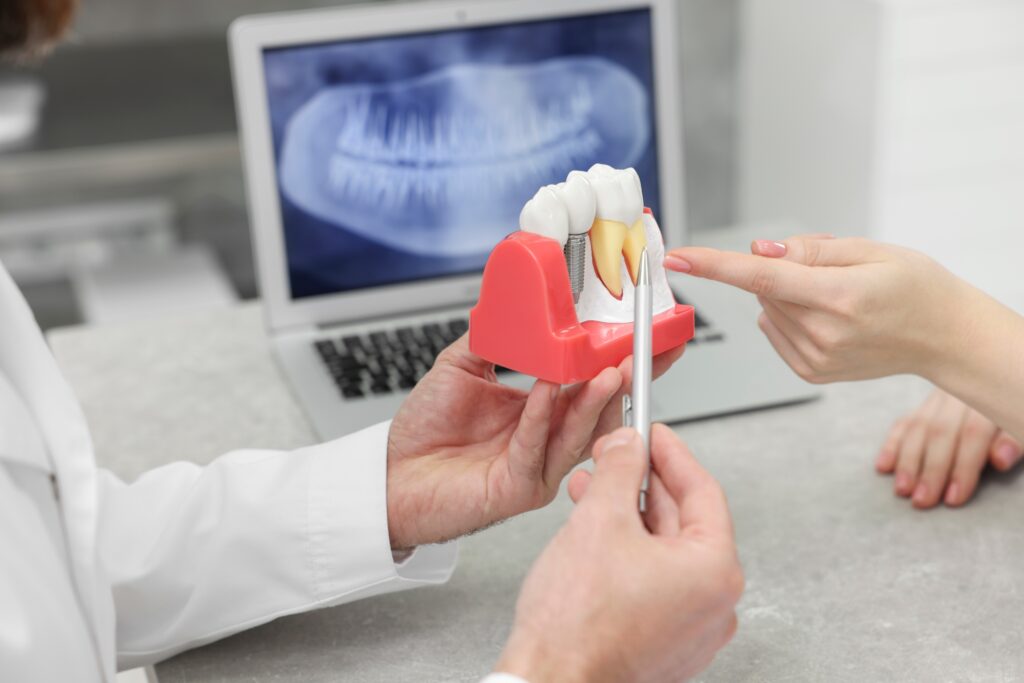
A dental implant is a titanium post placed in the jawbone that replaces the root of a missing tooth. Over 3 to 6 months it fuses with the bone through osseointegration, then supports an abutment and a custom crown. Implants replace 1 tooth, several teeth, or a full arch.
An implant has three parts. The post is the titanium screw placed in the jawbone. The abutment is the connector that sits on top of it at the gum line. The crown is the visible tooth, matched to the shade and shape of the teeth beside it.
What makes an implant different from a bridge or a denture is what happens under the gum. Osseointegration is the process by which bone grows against and bonds to the titanium surface, which takes roughly three to six months. Once that happens, the implant is anchored in your jaw the way a natural root is.
That anchoring does something a bridge cannot. Jawbone needs stimulation from a tooth root to maintain itself, and bone in the area of a missing tooth begins to resorb within the first year. An implant loads the bone when you chew, which slows that loss. This is why waiting to replace a missing tooth can change what treatment is even possible later.
For patients missing most or all of their teeth, implants can anchor a full arch instead of a single crown. See implant-supported dentures.
What Dental Implant Options Do You Offer?
McKinley-Holloway Legacy Dentistry offers 4 dental implant options at our Shelby Township office: single tooth implants, multiple implants, implant-supported dentures for a full arch, and mini dental implants for patients with limited bone.
Single tooth implant. One post, one abutment, one crown. The standard answer for a single missing tooth, and the option that leaves the teeth on either side untouched.
Multiple implants. Two or more implants supporting individual crowns or a fixed bridge across a gap. Fewer implants than missing teeth, because a bridge can span between them. See dental bridges.
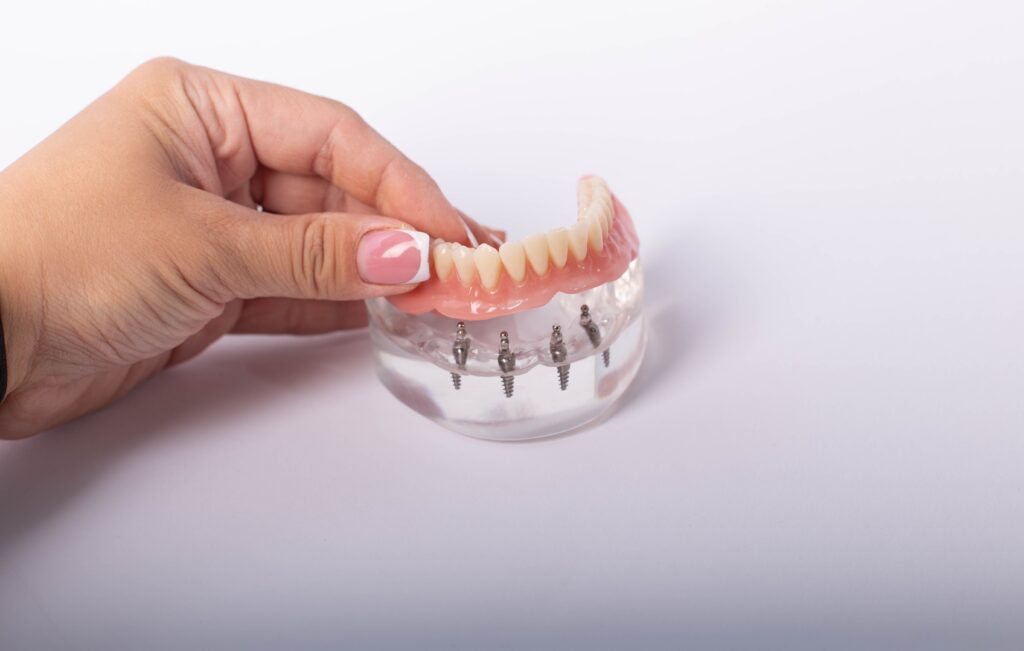
Implant-supported dentures. A full arch anchored on implants rather than resting on the gums. They do not slip, they do not need adhesive, and they restore far more chewing force than a conventional denture. See implant-supported dentures.
Mini dental implants. Narrower posts that can sometimes be placed where bone width would rule out a standard implant, often to stabilize a lower denture. See mini dental implants.
Which of these dental implant options fits you depends on how many teeth are missing, how much bone is there, and what you want the result to do. That is what the 3D scan at your consultation answers.
When Patients Come to Us About Dental Implants
- A single tooth lost to decay, infection, or injury
- A tooth that cannot be saved and needs extraction and replacement
- An old bridge that has failed or the teeth supporting it have decayed
- A denture that slips, clicks, or has to be held in with adhesive
- Several missing teeth in a row on one side
- A full arch of failing teeth that need to come out
- Bone loss in the jaw from teeth that were lost years ago
- Difficulty chewing on one side, or avoiding certain foods entirely
Am I a Candidate for Dental Implants?
Most adults with one or more missing teeth are dental implant candidates. You need enough jawbone to hold the post, healthy gums, and reasonable general health. Uncontrolled gum disease or diabetes is treated first, and heavy smoking lowers success rates.
Age is almost never the disqualifier patients expect. We place implants for patients in their seventies and eighties. What matters is bone and gum health, not the year on your chart.
Bone volume is the real gate, and it is the reason the 3D scan comes first. If a tooth has been missing for years, the bone in that spot may have resorbed past what an implant needs. That does not automatically rule you out, because bone grafting can rebuild the site, and mini implants sometimes work where a standard post will not. It does change the timeline and the cost, and you should hear that at the consultation rather than halfway through.
Active gum disease has to be resolved before placement, because the same bacteria that destroy bone around natural teeth will do it around an implant. If you need gum disease treatment first, we will say so.
4.9 stars, 400+ Google reviews
What Does the Dental Implant Process Look Like at Our Shelby Township Office?
The dental implant process takes 4 stages: a consultation with a 3D cone beam scan, placement of the titanium post, a 3 to 6 month healing period for osseointegration, and placement of the final crown. Some cases allow same-day placement.
Stage 1: Consultation and 3D scan. We take a 3D cone beam scan that shows bone depth, density, and nerve position. This is what tells us whether you are a candidate and where the implant can go. Free for new patients, a $200 value.
Stage 2: Planning and the surgical guide. The implant position is planned digitally, then we print a surgical guide on our in-office Formlabs printer. The guide fits over your teeth and holds the drill at the planned angle and depth, so placement follows the plan rather than freehand judgment.
Stage 3: Placement. The post is placed and a healing cap is fitted. Local anesthetic is delivered with The Wand, and laughing gas or oral conscious sedation is available. Most patients describe the recovery as easier than an extraction.
Stage 4: Healing and the final crown. Osseointegration takes roughly 3 to 6 months. Once the implant has fused, we take a digital iTero scan and make the crown, which our in-office ceramic mill produces without a two-week lab wait. See same-day dental crowns.
Some cases allow an implant and a temporary tooth the same day. Whether yours qualifies depends on bone quality and where the implant sits, and the 3D scan answers that at the consultation.

How Much Do Dental Implants Cost in Shelby Township, MI?
A single dental implant in the Shelby Township and Macomb, MI area generally runs about $3,000 to $5,000 including the post, abutment, and crown. Full arch implant-supported dentures run considerably higher. McKinley-Holloway Legacy Dentistry gives you a firm quote at your free consultation.
The number moves with what the case needs. A straightforward single implant with good bone sits at the low end. A case needing extraction, grafting, and a longer healing period sits higher. Full arch work is a different order of cost entirely, and we quote it separately.
Dental insurance coverage for implants varies more than for almost any other procedure. Some plans cover a portion of the crown but not the post, some cover neither, and some have a separate implant benefit. We verify your specific plan before you start, so the number you hear is the number you pay.
The Smile+ in-house dental plan takes 15 percent off implants and oral surgery with no waiting period. Adult Essential runs roughly $41 a month plus a one-time enrollment fee.
CareCredit, Cherry, and LendingClub are available through our dental financing options, and Cherry lets you check what you qualify for without a hard credit pull.
Are Teeth Implants Better Than Dentures or a Bridge?
Teeth implants last 20 years or longer and preserve jawbone, while a bridge lasts 10 to 15 years and a conventional denture rests on the gums without stimulating bone. Implants cost more upfront and take longer, but usually cost less over 20 years.
A bridge is faster and cheaper, and it requires grinding down the healthy teeth on either side of the gap to hold the crowns that anchor it. That is a permanent trade you make to save time and money now. Implants leave neighboring teeth untouched.
A conventional denture is the least expensive option and the one patients most often come back to replace. It sits on the gums, so it does not stimulate the bone underneath, and as that bone resorbs the fit changes. That is why dentures need relining and why they eventually slip.
None of this makes implants automatically right. If you need a solution in two weeks, or bone volume rules out placement, or cost is the deciding factor, a dental bridge or dentures and partial dentures may genuinely be the better call. Dr. McKinley-Holloway will tell you which one your case points to.
For patients replacing a full arch or rebuilding a worn bite, see full mouth restoration.
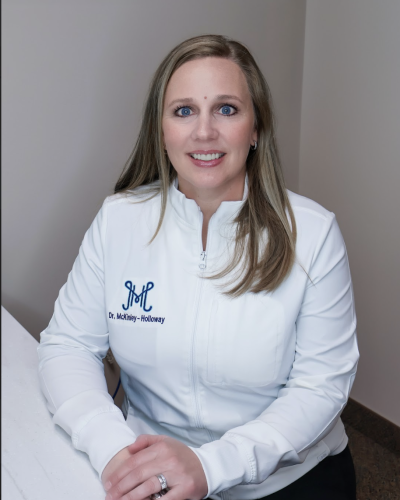
Meet Your Shelby Township Implant Dentist
Dr. Brittany McKinley-Holloway is a 2011 University of Detroit Mercy School of Dentistry graduate and the third generation of her family to practice dentistry in Macomb County. She plans, places, and restores implant cases in-house.
She is the only dentist in the practice, which changes what an implant case feels like from the patient’s side. There is no coordination between a surgeon’s office and a restorative dentist, no repeating your history twice, and no gap where a case gets handed off. The person who scanned your jaw is the person who seats your crown.
Her father, Dr. Ray Nelson McKinley, built this practice over nearly 48 years and worked until his last day. You can read about the McKinley family dental legacy here. Many implant patients here were his patients first.
Patients who are anxious about the placement appointment should know that laughing gas and oral conscious sedation are both available. See sedation dentistry in Shelby Township.
Do You Place Dental Implants for Patients From Macomb, Clinton Township, and Sterling Heights?
Yes. McKinley-Holloway Legacy Dentistry is at 45665 Village Blvd in Shelby Township, MI, and places dental implants for patients from Macomb, MI, Clinton Township, Sterling Heights, Washington Township, Utica, and Harrison Township.
Implant treatment runs across several appointments over several months, so the drive matters more here than on a single-visit service. Patients coming for dental implants from Clinton Township or Macomb, MI are generally 15 to 20 minutes out, and we open at 7 AM on Tuesdays and Wednesdays for the check-in visits.
Doing the whole case in one building matters most to the patients driving farthest. A patient from Sterling Heights is not making separate trips to a surgeon’s office and then a restorative dentist’s office for the same tooth.
If a tooth has broken or is causing pain and you need to be seen now, see emergency dental care, where same-day appointments are available. Extractions and related procedures are handled through our oral surgery services.

Find Out If You Are a Candidate, Free
Dental implants at McKinley-Holloway Legacy Dentistry are planned from a 3D cone beam scan, placed with a surgical guide printed in our own office, and finished by the same dentist who started them. New patients get the consultation and scan free, a $200 value. Ask our office for details. We are rated 4.9 stars across 400+ Google reviews and treat patients from Shelby Township, Macomb, MI, Clinton Township, Sterling Heights, Washington Township, Utica, and Harrison Township.

Dental Implants FAQs
A dental implant is a titanium post placed in the jawbone that replaces the root of a missing tooth. It supports an abutment and a custom crown on top, so the finished result looks and functions like a natural tooth. Unlike a bridge or a denture, an implant fuses with the bone and helps prevent the jawbone loss that follows a missing tooth.
Yes. Teeth implants and dental implants are two names for the same treatment, a titanium post placed in the jaw to replace a missing tooth root. You may also hear them called tooth implants or implant posts. All of these describe the same procedure we perform at our Shelby Township office.
A single dental implant in the Shelby Township and Macomb, MI area generally runs about $3,000 to $5,000, which typically includes the post, the abutment, and the crown. Cases needing extraction or bone grafting cost more, and full arch implant-supported dentures are quoted separately. You get a firm number at your free consultation, which is a $200 value for new patients.
Dental implants last 20 years or longer, and many last a lifetime. The titanium post fuses with the jawbone through osseointegration and becomes a permanent part of your jaw. The crown on top is the part that wears, and it typically needs replacement every 10 to 15 years. What shortens implant life is gum disease and smoking, not age.
The placement itself is not painful, because the area is fully numb. We use The Wand, a computer-controlled anesthesia system that delivers numbing medication slowly to one site, which removes the sting patients associate with a dental injection. Laughing gas and oral conscious sedation are available. Most patients say the recovery is easier than they expected, and easier than a tooth extraction.
Some cases can. Same-day placement means the implant and a temporary tooth go in at one appointment, though the bone still needs 3 to 6 months to fuse before the final crown is placed. Whether your case qualifies depends on bone quality and where the implant sits, which the 3D cone beam scan at your consultation determines.
Insufficient bone does not automatically rule out an implant. Bone grafting can rebuild the site, a sinus lift can create height in the upper jaw, and mini dental implants use a narrower post that sometimes fits where a standard implant will not. Bone loss is the reason we take a 3D cone beam scan before recommending anything, because it measures exactly how much bone is there.
Age by itself is not a disqualifier, and we place implants for patients in their seventies and eighties. What matters is jawbone volume, gum health, and whether any general health conditions affect healing. A 75 year old with healthy gums and good bone is a better candidate than a 40 year old with untreated gum disease.
Implants last longer and preserve more. A bridge requires grinding down the healthy teeth on either side of the gap to anchor it, and typically lasts 10 to 15 years. An implant leaves neighboring teeth untouched, lasts 20 years or more, and stimulates the jawbone so it does not resorb. A bridge is faster and less expensive upfront, which makes it the right answer for some patients.
Coverage varies more for implants than for almost any other procedure. Some plans cover part of the crown but not the post, some cover neither, and some carry a separate implant benefit. We verify your specific plan before treatment starts. Our Smile+ in-house dental plan takes 15 percent off implants with no waiting period.
Brush and floss them like natural teeth, and keep your regular cleanings. Implants cannot decay, but the gum and bone around them can develop peri-implantitis, an infection that behaves like gum disease and is the most common cause of implant failure. A water flosser helps around implant crowns, and we will show you the technique at your follow-up.